
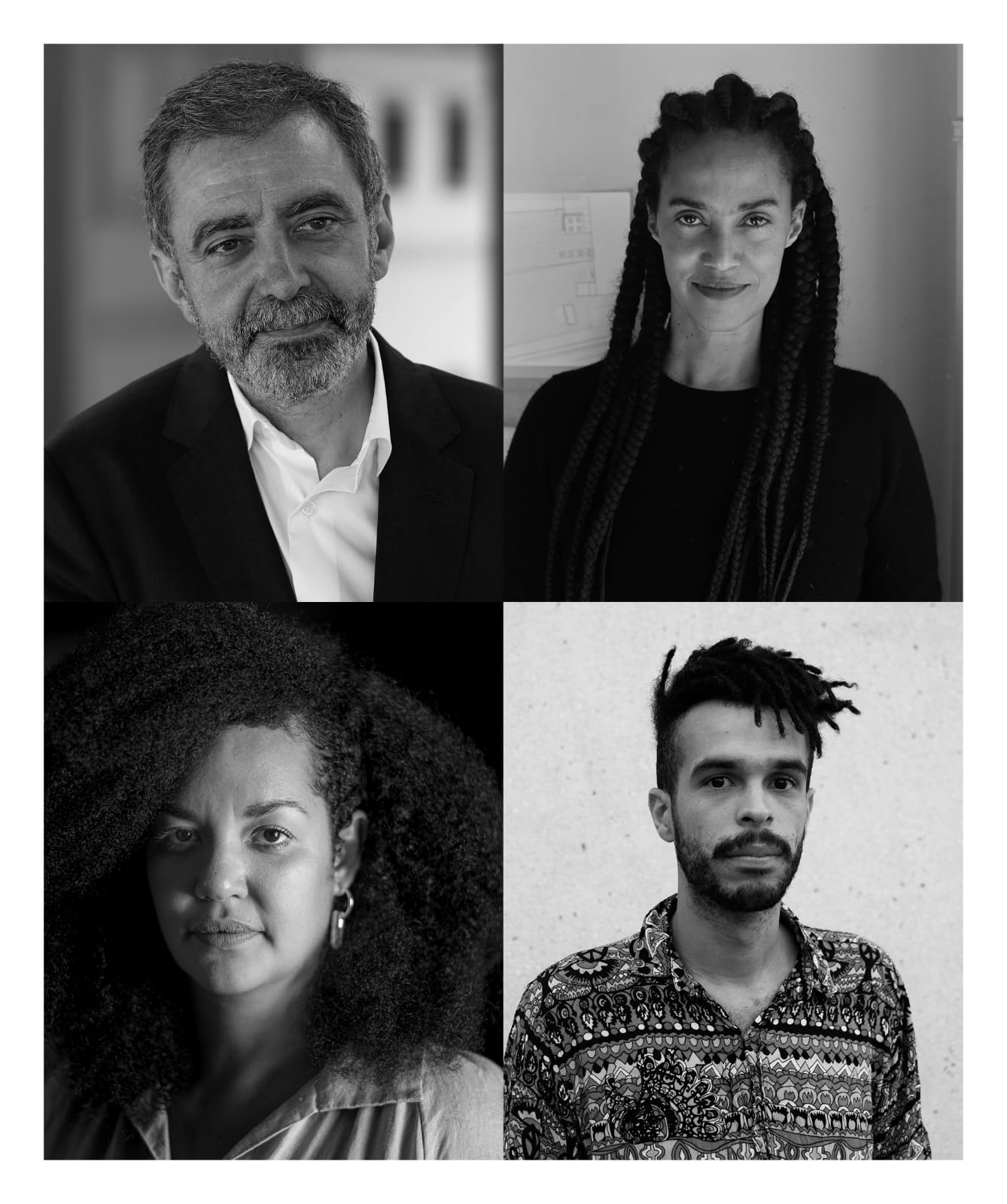
The next edition of the Bienal de São Paulo, which will take place in 2023, will have four curators. Manuel Borja-Villel, art historian; Grada Kilomba, multidisciplinary artist, writer and theorist; Diane Lima, independent curator, writer and researcher; and Hélio Menezes, anthropologist, critic and researcher, will develop the curatorial work of the event in a decentralized manner.
“The complementarity of these talents has the potential to generate fantastic results,” said José Olympio da Veiga Pereira, president of the Fundação Bienal. “The curatorial team was formed voluntarily and the proposal captivated us for being ambitious and intriguing”, he adds.
This curatorial model, without the figure of a chief curator, was already adopted in the 1989, 2010 and 2014 editions of the Bienal. “The idea of forming a group with a horizontal relationship was a suggestion by the team of curators and will be a constituent part of the project for the 35th Bienal”, concludes José Olympio.
The curators
The biographies below, listed in alphabetical order of surnames, choose not to present normative categories such as nation, nationality, age and year of birth. This is a guideline that will be part of the entire process of the 35th Bienal.
Manuel Borja-Villel – Lives in Madrid, Spain. Doctor in Art History from the City University of New York, since 2008 he has been director of the Museo Reina Sofía (Madrid, Spain), being responsible for the development and profound reinterpretation of the museum’s collection. In recent years, Reina Sofía has strengthened its position as a reference for cultural production through the work carried out with an asymmetrical network of institutions that includes, among others, museums, universities and independent institutions. He directed the Fundación Antoni Tàpies (Barcelona, Spain) from its creation in 1990 until 1998, and made the foundation an experimental institution with a program centered on institutional criticism. Already at the head of the Museu d’Art Contemporani de Barcelona from 1998 to 2008, he placed public management at the service of the citizen’s agenda, creating a place of dissent through radical pedagogy, criticism and institutional experimentation. He reflects on these and other themes in his latest book: Campos magnéticos: Escritos de arte y Política (Madrid: Arcadia, 2020).
Grada Kilomba – Lives in Berlin, Germany. Interdisciplinary artist, writer and PhD in philosophy from the Free University of Berlin, Germany, Kilomba has taught at several international universities, such as the University of Arts in Vienna, Austria. Her works raise questions about knowledge, power and cyclic violence, and have been exhibited at significant events such as the 10th Berlin Biennale; Documenta 14; La Biennale de Lubumbashi VI; and 32nd Bienal de São Paulo; as well as numerous international museums and theaters. Her art has different formats such as performance, scenic reading, texts, video and installation, focusing on memory, trauma, gender and post-colonialism. The works are part of public and private collections such as that of the Tate Modern (London, England).
Diane Lima – Lives between Salvador and São Paulo, Brazil. One of the Brazilians awarded by the Ford Foundation Global Fellowship, her projects became notable for broadening the debates on artistic and curatorial practices from a decolonial perspective in the country. She holds a master’s degree in communication and semiotics from PUC-SP and is part of the curatorial committee for the new long-term exhibition in the collection of the Museu de Arte Contemporânea da Universidade de São Paulo (MAC-USP). Among her recent works are the co-curatorships of Frestas – 3rd Trienal de Artes do Sesc SP – O rio é uma serpente [The River is a Snake], in 2021, and Vuadora, a retrospective exhibition for the artist Paulo Nazareth at Pivô.
Hélio Menezes – Lives in São Paulo, Brazil. Anthropologist and internationalist at the Universidade de São Paulo and an affiliated scholar at the BrazilLab at Princeton University. He was curator of contemporary art at Centro Cultural São Paulo from 2019 to 2021, where he also served as curator of literature between March and October 2019, and international coordinator of the World Social Forum in Belém (2009), Dakar (2011) and Tunis (2013). Some of his most recent works are Carolina Maria de Jesus: A Brazil for Brazilians (IMS Paulista), Histórias Afro-Atlânticas (MASP and Instituto Tomie Ohtake) and dos brasis (Sesc). In 2021, he was acknowledged by ArtReview Magazine as one of the 100 most important people in contemporary art in the world.