

Beginning on 6 September 2014 (preview on 1-5 September), the 31st Bienal de São Paulo will be titled How to talk about things that don’t exist. Established by the curatorial team – Charles Esche, Galit Eilat, Nuria Enguita Mayo, Pablo Lafuente and Oren Sagiv as well by the associate curators Benjamin Seroussi and Luiza Proença – the title is a poetic call to put the capability of art at the centre of the event.

The verb in the title will constantly change, anticipating various actions that these things that don’t exist might require in order to be made present. For the poster image we will ‘talk about’ things that don’t exist; later we will ‘live with’; ‘use’; ‘struggle against’ or ‘learn from’ things that don’t exist at different times and on different platforms. The key to thinking about things that don’t exist is to imagine that human understanding and decision-making are always partial and confined by limited expectations and beliefs. The things that do not exist are outside the commonly accepted frame of thinking and doing in any given society at any one time.

In an age when the world exchanges more and more information, there is a paradoxical reduction in the diversity of social frames, and certain forms of this shared ‘common sense’ become oppressive. Our contemporary economic model, for instance, which brooks no opposition; or the cold logic of efficiency that often ignores history and culture, are belief systems that are much more widely dominant than in the past, and accepting them is almost essential for our survival. The ‘things that don’t exist’ are those aspects of human experience and emotion that usually fall outside language. They touch on the limits of understanding and involve questions of visibility or invisibility, collectivity and conflict as a fact and a tool, the transformative potential of art and culture, and the possibility to imagine the world differently.

The conviction of the curatorial team of the 31st Bienal is that art can offer encounters with experiences and emotions that are not present in most analyses of human life. If individuals or groups within a society can recognise, through art, the things that they cannot acknowledge through other means, then they might be empowered to transform themselves in unpredictable ways. The hope of the 31st Bienal is that it can conjure these things into existence through artistic acts of will. Perhaps this is, in the end, the core function of art both historically and today.
Visual Identity
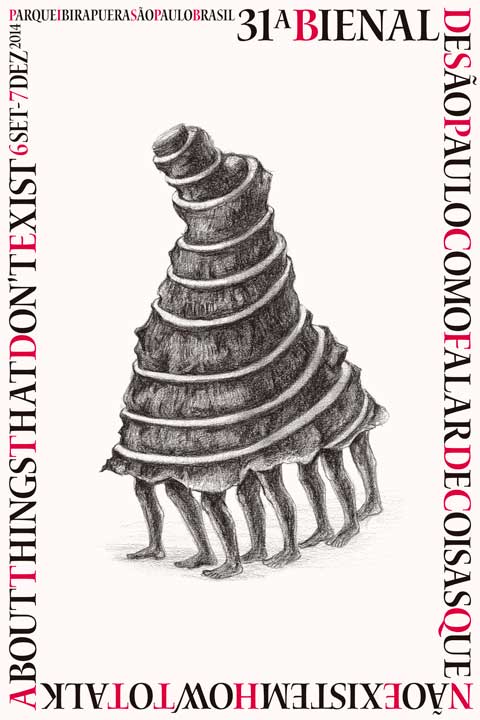
The 31st Bienal de São Paulo’s visual identity takes its lead from the title of the Bienal. It was developed together by the curatorial and in-house design teams and is based on a commissioned drawing and a typographic frame. The central image of moving tower under human propulsion is by the artist Prabhakar Pachpute. The calligraphic composition in black and red frames and contextualises the image.

The process for developing this identity started in September 2013 with a series of discussions that outlined the basic curatorial questions for this Bienal. The conversation was intensified through a work of exchange and analysis of images. Gradually a set of images stood out: spirals and knots reappeared over and over as well as other intricate forms including organic figures emerging from pre-modern societies. Needing a further step and something tailor-made for our developing ideas, the team invited Prabhakar Pachpute to compose a unique image. Pachpute is an artist who comes from a mining area in Central India and whose imaginative drawings of people seemed to resonate with the identity of the 31st Bienal. The resulting drawing responded to the early ideas of the curators looks like an impossible conglomeration of bodies inside a fragile Tower of Babel structure. Being mobile, it stresses the urge to come together and walk in common towards an uncertain destination. The fantastical aspect of this figure, which also recalls a many-legged organism, depicts an imagined collectivity and the mental and physical transformation crucial to the curatorial approach of this Bienal.
In the poster, the drawn image is framed by a calligraphic type that suggests handmade manufacture. This sets the tone for an intimacy in the relations between art, mediation and audiences that we are aiming for in the 31st Bienal. It uses a typeface based on the work of English calligrapher Julian Waters and ‘Arrus’ by Richard Lipton. The overall composition uses the canvas limits as guidelines, its awkwardness affirming the central role of typography in the visual identification. Within this composition, colour appears punctually, highlighting the beginning of words according to the needs of the communication.
More information about Prabhakar Pachpute