• Accessibility
      Font
    • A+
    • Aa


  • Events
  • Search
  • en
    • pt
  • Bienal
  • About Us
  • From Bienal to Bienal
  • Events
  • +Bienal
  • Library
  • Historical Archive
  • Partners
  • Transparency
  • Bienal Café
  • Contact us
  • Press
  • Visual Identity
Home News Tales from the foot of the Baobab

15 Oct 2014

Tales from the foot of the Baobab


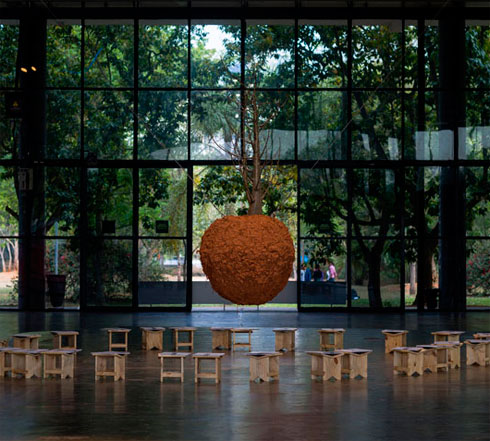
The baobab is perhaps the world’s most ancient living thing, reaching up to 6,000 years old. A tree that has witnessed times immemorial, and is the guardian of all its stories. So what tales would we like to tell it? What stories would we want it to store for future generations? Grupo Contrafilé and Campus in Camps invite you to sit in on some storytelling and discussion at the foot of the baobab, part of #31Bienal’s Mujawara da Árvore-Escola (Mujawara – in Arab, ‘neighbourliness’– of the Tree-School).


October 25, Saturday • 2.30pm – 5.30pm

O Retorno [The Return], with the group Não em Nosso Nome

Vida e morte da árvore no antropoceno [Life and Death of a Tree in the Anthropocene], with Pedro Cesarino


November 1, Saturday • 2pm – 5pm

Chamado da terra [Call of the Earth], with MOPAT (The Palestine for All Movement)

A arte de sediar existência – uma história em defesa do território artístico e cultural [The Art of Hosting Existence – a Story in Defense of Artistic and Cultural Territory], with Núcleo Bartolomeu de Depoimentos


November 15, Saturday • 2pm – 5pm

Palavras soltas no colo de um baobá [Loose Words in the Baobab’s Lap], with Maurinete Lima

A árvore da vida e o baobá [The Tree of Life and the Baobab], with Peter Webb

Sou porque somos [I Am Because We Are], with TC Silva


| images 1, 3 and 4: ©Leo Eloy / Fundação Bienal de São Paulo

| image 2: ©Sofia Colucci / Fundação Bienal de São Paulo

Read too


Access +bienal
Uma grande escultura que lembra um tronco de árvore com raízes, feita de longas tiras de tecido suspensas em tons de marrom, laranja e amarelo. Em sua base, várias pedras naturais estão dispostas sobre pequenas placas escuras no piso de concreto de uma galeria.
Installation view of Terra viva by Marlene Almeida during the 36th Bienal de São Paulo© Natt Fejfar / Fundação Bienal de São Paulo
Interviews24 Jul 2026

Living Earth: Interview with Marlene Almeida

Earth samples collected from different regions of Brazil are processed into pigments or left in their raw state in a kind of laboratory. A sculpture composed of long strips of fabric dyed with natural pigments evokes a rock or a network of trails waiting to be explored. Technique and poetics come together in Terra viva [Living Earth] by Marlene Almeida, an installation created especially for the 36th Bienal de São Paulo. The work is now part of the Bienal’s traveling exhibition in Fortaleza. Read the artist’s statement.

Learn more
Uma pessoa com cabelo curto e encaracolado, vestindo uma camisa branca, um colete estampado e calças largas escuras, está em meio a uma instalação de arte. A instalação apresenta inúmeras hastes de metal escuras e retorcidas, semelhantes a raízes ou galhos, que cobrem o chão e se elevam ao redor da pessoa. Cortinas altas, de cor laranja claro, estão ao fundo.
Artist Rebeca Carapiá with her sculptures during the 36th Bienal de São Paulo© Levi Fanan / Fundação Bienal de São Paulo
News23 Jun 2026

How to grow aerial roots: interview with Rebeca Carapiá

The walking palm trees known as paxiúbas (Socratea exorrhiza) were Rebeca Carapiá’s companions during the days she spent along the Tupana River in the Amazon basin. Using steel, carbon, and copper, the artist spent months casting a forest of sculptures centered on an exploration of language, transformation, wandering, the body, life, and death. Her works are now part of the traveling exhibition of the 36th Bienal in Santos. Read the artist’s full statement below.

Learn more
Foto da equipe curatorial da 37ª Bienal, que é composta de nove pessoas, todas de pé, uma ao lado da outra, diante do vão central do Pavilhão da Bienal, um prédio branco, com rampas curvadas, uma coluna central e outras laterais. As pessoas são de diversas cores, etnias e idades, e estão todas usando roupas com tons escuros, e sorriem.
From left to right: Rado Ištok, Mayara Carvalho, Amanda Carneiro, Ryan Inouye, Yina Jiménez Suriel, Ana Salazar Herrera, Amanda Tavares, Raphael Fonseca, and Léuli Eshrāghi, the curatorial team of the 37th Bienal de São Paulo.© Camila Tuon / Fundação Bienal de São Paulo
News2 Jun 2026

The Fundação Bienal de São Paulo announces the curatorial team for the 37th Bienal de São Paulo

The curatorial team, led by chief curators Amanda Carneiro and Raphael Fonseca, brings together nine professionals from across the globe.

Learn more

Newsletter

Subscribe to the Bienal newsletter

Bienal

  • About Us
  • From Bienal to Bienal
  • Events
  • +Bienal
  • Library
  • Partners
  • Bienal Café
  • Transparency

  • Contact us
  • Visual Identity

Fundação Bienal de São Paulo

Av. Pedro Álvares Cabral, s/n - Moema CEP 04094-050 / São Paulo - SP

Contact

+55 11 5576.7600 contato@bienal.org.br

Privacy
•
Terms of use
Copyright © 2026 Bienal de São Paulo
Ao clicar em "Concordar", você concorda com uso de cookies para melhorar e personalizar sua experiência, bem como nossa Política de Privacidade. Ver a Política de Privacidade*.
Concordar