
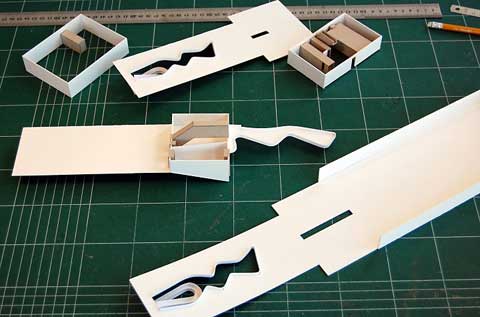

Cardboard Models for 31st Bienal | Courtesy: Oren Sagiv Studio
The 31st Bienal as an exhibition
As the opening date of the 31st Bienal approaches, the focus has been on the construction of the exhibition in the Pavilion at Ibirapuera Park and on working with the invited artists and participants and their new productions. At this stage it is possible to imagine how the projects and artworks will look together in space and how they can connect to each other. This second press release concentrates on the content of the exhibition and is intended to complement the first press release that outlined the conceptual starting points of the 31st Bienal. In August, a third press release will bring the complete list of participants and information about the temporal programme of talks, screenings and discussions.
Projects, artworks, architecture, and participants
1. A word about ‘projects’
The exhibition part of the Bienal will contain more than 70 projects, produced by about 100 participants and totalling around 250 artworks. The word ‘project’ is intended to create a distance from the traditional idea of an autonomous artwork made in a studio by an artist. By using this word, we can introduce a broader range of contemporary cultural practices, and include people working in other disciplines, such as educators, sociologists, architects, performers. The term also serves to encourage collaboration and trans-disciplinary ways of working amongst the Bienal participants. Each project is an independent contribution but may consist of many artworks by individual or collective authorship. More than half the projects have been made specifically for this Bienal, many by international artists who have produced work in response to a residency in the city and the opportunity to travel further in Brazil.
2. Architecture: the pavilion divided
A crucial aspect of the 31st Bienal is the way the Ciccillo Matarazzo pavilion is understood as divided into different areas, each with its own architectural logic and particular qualities. The ground floor is called Park, and is connected and opened up to the surrounding landscape, to become a space for reception, events and meetings. The Ramp adapts to the verticality and the circulation of the pavilion’s main access route (the ramp) to create a series of curvaceous spaces linked by a monumental spiral. Here, the artworks and projects are shown without enclosing rooms, and are related to each other both vertically and horizontally. The Columns articulates the largest continuous space of the pavilion on the second floor, dividing it into densities with areas of light and shadow, or sound and silence, that create an interplay of experiences. A small, central area isolates some singular artistic statements and the three different areas from each other.
3. Densities of artworks
The interpretation of the basic architectural structure of the pavilion also serves as the key organisational device in installing the exhibition and relating projects one to another. The thinking behind the installation has been to assemble ‘densities’ that explore different aspects of the ‘things that do not exist’ referred to in the title. These densities are constructed around shared concerns in the projects, creating a sense of possible interconnection between different places and times. For instance, the Park area has the most publicly activated works as well as spaces for meeting and discussing. On Ramp´s first floor, the focus is on shared urban space. The second floor gathers work related to accumulating knowledge and new possibilities for storytelling. The third relates to the common roots and forms of spirituallity. Finaly, in the Columns, the suggestion of the journey is strong, as is the presence of projects dealing with the idea of the trans- and the turn as a way to express an aspiration for a different society.
4. Artists and projects: Facing the present
While the Modern Movement has an affective and vital history in Brazil, it is no longer representative of a living present. Therefore the aesthetic criteria of modernism and the striving towards progress are not prominent in the 31st Bienal. While some projects will reference the period, in most cases the modern is simply not a force that is at stake for the artists’ research and work. This approach to the recent past means that a different hierarchy of sources and inspirations can be established, one that recognises the possibilities in the pre-modern and the non-modern, or in the spiritual and popular culture, to offer different readings of contemporary conditions. It also means that the influence of collective imagination, social activism and political conflict is as significant as the heritage of artistic practice to the artists in the 31st Bienal.