• Accessibility
      Font
    • A+
    • Aa


  • Events
  • Search
  • en
    • pt
  • Bienal
  • About Us
  • From Bienal to Bienal
  • Events
  • +Bienal
  • Library
  • Historical Archive
  • Partners
  • Transparency
  • Bienal Café
  • Contact us
  • Press
  • Visual Identity
Home News The Orion Shadow

12 May 2014

The Orion Shadow


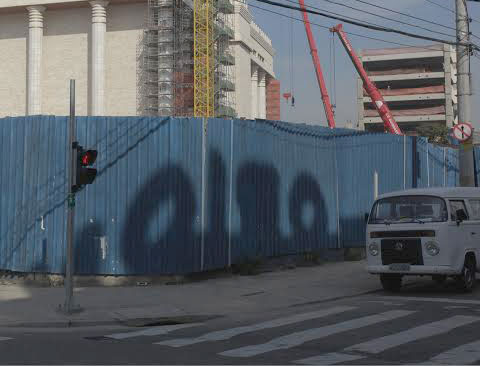
Canadian artist Mark Lewis investigated the streets of São Paulo and gave us his testimony.


"For me one of the most extraordinary things about São Paulo is the sheer number of modern buildings from the 1920's and 30's through to the 1970's. Of course there are the signature buildings by the great architects such as Niemeyer and Lina Bo Bardi. But I have been stunned by the existence of hundreds of other graceful and beautiful buildings, presumably by architects lesser known or long forgotten. I live and work in a city, London, that has an immense and collective hostility to the modern and today there are very few of these kinds of buildings left there. One of my favourite São Paulo buildings is the old Orion rubber factory on Rua Behring, abandoned by the company in the 1980's and now lies empty and rather dilapidated. But  somehow the building still stands proud even though, or perhaps because across the street from it rises the grotesquely oversized 'Temple of Solomon' built by the Universal Church of the Kingdom of God. The two Orion signs, hollowed out of concrete, sit majestically on top of the building on each of its street sides. On clear Sao Paulo mornings the sun sits behind one of the signs and throws the latter's shadow onto the blue construction fence surrounding the building site of the Temple of Solomon. When the Orion building was designed and built, like many modern buildings of its time, it had the future in mind. I think the Orion Shadow remind us that great buildings like great art, continue to have the future in mind even when defeat seems most likely".


Read too


Access +bienal
Uma pessoa com cabelo curto e encaracolado, vestindo uma camisa branca, um colete estampado e calças largas escuras, está em meio a uma instalação de arte. A instalação apresenta inúmeras hastes de metal escuras e retorcidas, semelhantes a raízes ou galhos, que cobrem o chão e se elevam ao redor da pessoa. Cortinas altas, de cor laranja claro, estão ao fundo.
Artist Rebeca Carapiá with her sculptures during the 36th Bienal de São Paulo© Levi Fanan / Fundação Bienal de São Paulo
News23 Jun 2026

How to grow aerial roots: interview with Rebeca Carapiá

The walking palm trees known as paxiúbas (Socratea exorrhiza) were Rebeca Carapiá’s companions during the days she spent along the Tupana River in the Amazon basin. Using steel, carbon, and copper, the artist spent months casting a forest of sculptures centered on an exploration of language, transformation, wandering, the body, life, and death. Her works are now part of the traveling exhibition of the 36th Bienal in Santos. Read the artist’s full statement below.

Learn more
Foto da equipe curatorial da 37ª Bienal, que é composta de nove pessoas, todas de pé, uma ao lado da outra, diante do vão central do Pavilhão da Bienal, um prédio branco, com rampas curvadas, uma coluna central e outras laterais. As pessoas são de diversas cores, etnias e idades, e estão todas usando roupas com tons escuros, e sorriem.
From left to right: Rado Ištok, Mayara Carvalho, Amanda Carneiro, Ryan Inouye, Yina Jiménez Suriel, Ana Salazar Herrera, Amanda Tavares, Raphael Fonseca, and Léuli Eshrāghi, the curatorial team of the 37th Bienal de São Paulo.© Camila Tuon / Fundação Bienal de São Paulo
News2 Jun 2026

The Fundação Bienal de São Paulo announces the curatorial team for the 37th Bienal de São Paulo

The curatorial team, led by chief curators Amanda Carneiro and Raphael Fonseca, brings together nine professionals from across the globe.

Learn more
View of Sérgio Soarez's work during the 36th Bienal de São Paulo© Julia Bolliger Murari / Fundação Bienal de São Paulo
Interviews20 May 2026

The griot artist who converses with ancestrality: an interview with Sérgio Soarez

Through assemblage, Sérgio Soarez brings together iron objects — such as keys, knives, drill bits, pliers and tools – and wooden objects – such as blocks, rocaille, simple planks and ornaments – to coexist, combining different lives, times and uses, the traces of which are etched into their forms. His works are now part of the travelling exhibition of the 36th Bienal in Brasília. Read the artist’s statement below.

Learn more

Newsletter

Subscribe to the Bienal newsletter

Bienal

  • About Us
  • From Bienal to Bienal
  • Events
  • +Bienal
  • Library
  • Partners
  • Bienal Café
  • Transparency

  • Contact us
  • Visual Identity

Fundação Bienal de São Paulo

Av. Pedro Álvares Cabral, s/n - Moema CEP 04094-050 / São Paulo - SP

Contact

+55 11 5576.7600 contato@bienal.org.br

Privacy
•
Terms of use
Copyright © 2026 Bienal de São Paulo
Ao clicar em "Concordar", você concorda com uso de cookies para melhorar e personalizar sua experiência, bem como nossa Política de Privacidade. Ver a Política de Privacidade*.
Concordar