• Acessibilidade
      Fonte
    • A+
    • Aa


  • Agenda
  • Busca
  • pt
    • en
  • Bienal
  • fundação
  • bienal a bienal
  • Agenda
  • +bienal
  • biblioteca
  • Arquivo Histórico
  • 70 anos
  • apoie
  • café bienal
  • transparência
  • relatório de gestão 2022-2023
  • Imprensa
  • contato
  • identidade visual
  • trabalhe conosco
Home Notícias Balayer – A Map of Sweeping

17 set 2014

Balayer – A Map of Sweeping

2014

Imogen Stidworthy
in collaboration with Gisèle Durand-Ruiz and Jacques Lin

and with the participation of Christoph Berton, Gilou Toche and Malika Bolainseur


Imogen Stidworthy’s project for the 31st Bienal revolves around a network of temporary homes for autistic children set up by the French writer and pedagogue Fernand Deligny in 1967, around the village of Monoblet in the Cévennes, southern France. Rather than psychiatric care, it was an experience of communal living that was on offer in these farmhouses: therapists were replaced by untrained social workers, and isolation by life out in the open. In this way, Deligny sought to create an environment that responded to the children’s way of being-in-the-world, notably their withdrawal from language. Verbal communication was therefore dispensed with and visual tools such as map-making, photographs and films were used to interpret their gestures and wanderings.
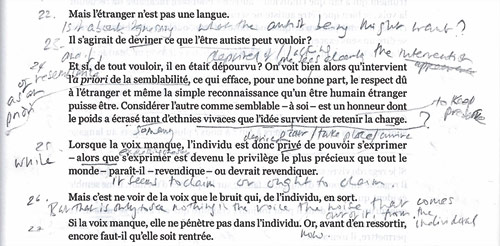


Although the network ceased to operate in the early 1980s, Deligny’s collaborators Jacques Lin and Gisèle Durand continue to live with autistic adults in one of the farmhouses – two of these adults arrived as children in the late 1960s. Building upon her ongoing enquiry into the borders of language, Stidworthy has worked with them to consider the legacy of Deligny’s project and reflect upon what being without language might indicate about the ways in which language constructs our sense of self and thus structures – as well as restricts – our engagement with the world.
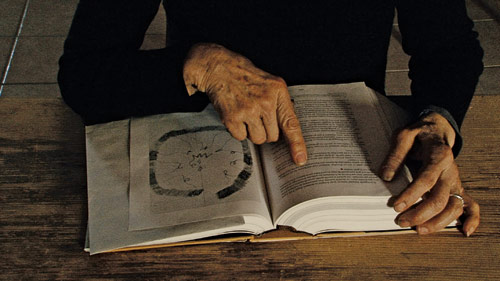


Each component of Stidworthy’s installation focusses on a particular cultural practice devised by Deligny in his attempt to take account of the relation with the autistic persons, and of their worldview – namely tracing, ‘camering’ and writing. Attentive to their heightened perception of the material world, Stidworthy has filmed them as they work with Gisèle Durand in a project that she initiates from time to time, involving tracing on paper – an activity that Deligny distinguished from drawing to emphasise its unintentional basis. A similar lack of purpose underpins Deligny’s notion of ‘camering’: an aimless filming that we can recognise in the installation in images made from a ‘detached’ and, to a degree, un-authored camera position. We also see unedited video recordings taken by Lin over years, raw material for a future film captured through an embedded, insider’s eye. Finally, Deligny’s unusual style of writing – here translated live from the French – reveals his attempt to defy language within language. His struggle to counter the rules of the written word thus dovetails with Stidworthy’s own efforts to question the neutrality of language. – HV

Leia também


Acessar +bienal
Foto de pessoas manipulando croquis de projeto expográfico. Elas usam luvas e são vistas de cima.
Projeto expográfico do escritório de arquitetura Vão para a 35ª Bienal de São Paulo no Arquivo Histórico Wanda Svevo da Fundação Bienal de São Paulo© Levi Fanan / Fundação Bienal de São Paulo
Notícias14 maio 2026

Arquivo Histórico Wanda Svevo é declarado de interesse público e social pelo CONARQ

Reconhecimento federal consolida a importância do Arquivo Histórico Wanda Svevo para a memória da arte moderna e contemporânea brasileira.

Saber mais
Notícias14 maio 2026

Fundação Bienal abre inscrições para seleção de supervisor de operações de eventos

Buscamos um profissional experiente para atuar como Supervisor de Operações em uma das mais importantes instituições culturais da América Latina, reconhecida internacionalmente por promover a divulgação da arte contemporânea, com grande influência no desenvolvimento das artes visuais brasileiras. Localizada no Parque Ibirapuera, em São Paulo, opera em um icônico pavilhão modernista projetado por Oscar Niemeyer. A instituição é responsável pela criação e organização da Bienal de São Paulo e suas itinerâncias, além das participações brasileiras nas Bienais de Arte e Arquitetura de Veneza.

Saber mais
Foto de duas pessoas lado a lado na rampa do Pavilhão da Bienal. A pessoa ao lado esquerdo é uma mulher alta, de cabelos soltos encaracolados, sorrindo, de pele negra, usando um terno em alfaiataria. Ao lado direito, um homem branco está com o braço apoiado no guarda-corpo, mais sério, com cabelos raspados, usando um terno escuro com detalhe em vermelho. O prédio atrás é branco e possui curvas sinuosas.
Retrato de Amanda Carneiro e Raphael Fonsceca, curadores-chefes da 37ª Bienal de São Paulo© Fe Avila / Fundação Bienal de São Paulo
Notícias28 abr 2026

Fundação Bienal de São Paulo anuncia Amanda Carneiro e Raphael Fonseca como curadores-chefes da 37ª Bienal de São Paulo

Com trajetórias construídas entre o Brasil e os principais eventos e instituições de arte do mundo, a dupla assume a curadoria da edição prevista para 2027 no Pavilhão Ciccillo Matarazzo.

Saber mais

Newsletter

Receba a Newsletter da Bienal

Bienal

  • Fundação
  • Bienal a Bienal
  • Agenda
  • +bienal
  • Biblioteca
  • 70 anos
  • Arquivo Histórico
  • Apoie
  • Café Bienal
  • Transparência
  • Relatório de Gestão 2022-2023

  • Contato
  • Identidade Visual

Fundação Bienal de São Paulo

Av. Pedro Álvares Cabral, s/n - Moema CEP 04094-050 / São Paulo - SP

Contato

+55 11 5576.7600 contato@bienal.org.br

Privacidade
•
Termos de uso
Copyright © 2026 Bienal de São Paulo
Ao clicar em "Concordar", você concorda com uso de cookies para melhorar e personalizar sua experiência, bem como nossa Política de Privacidade. Ver a Política de Privacidade*.
Concordar