
What is the place of fundamental opposition between the sensible and the intelligible? What are the specific skills for the construction of thought in art? Are there any?
The justifications are always attempts to define the limits of contributions from each realm, in the very dynamic of internal disputes in the art world. Yet it is in the limits established by the disciplines that strategic points of possible intersections of thought come together, where the blossoming – in the context of spring, the season which saw the opening of the 31st Bienal de São Paulo / Porto Alegre – takes place. It is in the intervals that room emerges for the development of new signs of identity and innovative collaborative posts. In encounters, by favoring marginal situations, contaminating the limits, rather than restricting points of contact, the option is to enhance them.
The social actors involved in the exchange, an inter/multi/cross/trans group, configure pairs that are familiar in the local context. With the contamination of disciplines comes an affirmation: it is the art world’s destiny to break boundaries (including speculating on the possibilities of rupturing physical boundaries), to interact with other areas of social life, to open up for the inclusion of other actors, to question the present, to go beyond. Is this interface between the inter/multi/cross/trans, which is so exploited in the sociological, political, economic approach, also valid from an aesthetic perspective of the discussions concerning contemporary art?
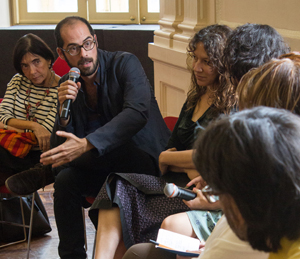
While there is a curatorial intention in the proposition of an encounter, its reception also depends on, parallel and simultaneous to, an intention on the part of the “guests” to “allow themselves to get involved” with and in the encounter. An involvement with the other and with art signifies a mobilization of affectivity.
In the process of constructing exhibition events, perhaps art’s “new powers” lies in each figure’s potential for contribution and no longer in the exclusive figure of a “leader” (or a curator or curators, to mention here this fundamental catalyst in exhibitions). The dilution of the “potency” centered on the figure of the curator may yield a model for sharing which also extends to the spectator, prone to communication, narrator and translator at the same time. Just like the works of art, spectators are points of extremely high informational density. In the relationship between the parts in the encounter, in the information generated at the points of distancing and approximation, it becomes possible to speculate on the modification of the nature of the ensemble and, perhaps, allow for the construction of significant changes in an exhibition context through the endless possible relationships between the components.
According to the aesthetic regime proposed by Rancière (2009), art is identified with the singular and is disconnected from all specific rules, from the entire hierarchy of subjects, of genres and arts. In the art of the encounter, in the mutual availability (curatorship-spectator) lies the configuration of a model of articulation between ways of creating and thoughts about forms of visibility of these ways of creating, including reflections about how to make these processes visible.
It is the view of the other, the foreign view, the other view from local instances, that permits the besetting of the anxieties and tensions of our time. It is the validation of the importance of the context linked to the validation valorization of the present time. In the encounter, configured in a situation of deviation – understood here as each figure’s ability to transport his or herself to the place of the other, with no need “to needprecise” a destination, or to have an answer – we weren’t introduced to something (in this case, a curatorial project for an exhibition in a closed and vertical model). While in art, our growing anxiousness is the aesthetic experience and the acquisition of answers for the “un-veiling” of the senses, when we are faced with an inversion of the “reception” of a curatorial proposal for the inquiry of what it consists of nowadays, we are offered questions. As a reversal comes the estrangement: in our DNA is the very Hegelian idea of a self-sufficient art or an art that alone communicates its intentions as an “unveiling of the truth,” one of the great myths of modernity which we inevitably tend to perpetuate. We are surprised when there are no answers: in the present tense, we are assaulted by questions.
How soon is now?
In the absence of answers, something is also said to us. Perhaps that it will never be possible to end the impulse that rouses us to begin, and the certainty that the “never” and this “void” can also be integral components of the experience. From the uncertainties and questions that arise from limit situations that we witness in depth and extension in the political and economic context, comes a difficulty for reflection on the present tense. The here and now is constituted by the old, by the “traditional accumulations,” by the “past burdened by nows,” as Benjamin reminds us (1994). And today, in the arts, this is also reflected both in curatorial proposals and artistic proposals that are challenged to evoke a “feeling of presence,” this idea of the “there” in works and exhibitions.
In the relationships between aesthetics and politics, a shared common (and exclusive parts). The crisis of meaning in representation (mainly institutional representation), configured in previous actions which erupted on the streets of Brazil in the events of June, have implications in the abandonment of beliefs about organizations as forefronts of the masses. This discussion is present in the arts, in our society of avid consumption of the “global spectacle” (often also acted out in the big exhibitions): the crises of political representations are very close to the crises of presentation in art (mainly institutionalized presentation). And the biennial exhibition models are placed in this realm of institutionalization. How can we allow for structural changes in biennial art events while maintaining a parallel responsibility in continuity?
Uncanny (or when the familiar becomes strange and the strange becomes familiar)
Something in between the strange and the familiar, which manages to be seen as something of acquaintance and at the same time appears completely unknown: a disturbing foreignness that fascinates by the presence of an absence of objectivity in its relationship of opening (the encounter). This shared feeling takes place in the realm of pairs, of the familiar with familiarities – here with a double meaning: an aporia, like a clear and evident familiar meaning and, simultaneously, with a hidden meaning characteristic of all that doesn’t belong to the family, like the figure of the other, that which comes from the outside.
Thought on the possibilities of reconfiguring traditional exhibition models touches on the curatorial practice of approximation, of sharing, of the availability for talking and listening in the generous art of the encounter. A starting point based in equality for other possible constructions, which can be found in the very transformations of forms of relationships. Equality is fundamental and absent, it is current and tempestuous, always depending on the initiative of individuals and groups which, contrary to the natural course of things, assume the risk of verifying it, inventing new forms, individual or collective, for its verification.
In the present tense of doubt, while we observe, discuss and venture to act, we understand that art is also a process of reflection. If curating is sharing, then we have a possible movement towards horizontality in view – one that has been long-awaited.
text: Michelle Sommer